
 ₹500 off
Types of Company Registration in India
Start your business seamlessly with expert guidance. Whether you're forming a private limited company (Pvt Ltd), LLP, or any other entity, we ensure a hassle-free process by managing everything from documentation to government approvals.
Private Limited Company Registration
Ideal for startups, offering limited liability and simplified venture capital raising. Secure investor funding effortlessly and protect your personal assets.
Private Limited Company Registration
Ideal for startups, offering limited liability and simplified venture capital raising. Secure investor funding effortlessly and protect your personal assets.
Private Limited Company Registration
Ideal for startups, offering limited liability and simplified venture capital raising. Secure investor funding effortlessly and protect your personal assets.
Private Limited Company Registration
Ideal for startups, offering limited liability and simplified venture capital raising. Secure investor funding effortlessly and protect your personal assets.
Register your business outside India
Take your business global with Advantus's expert guidance.

5 Types of Company Registration in India
Under the Companies Act of 2013 different types of business entities can be registered. Each and every business entity has its own set of benefits and drawbacks. Here is a complete outline of different business entities and their corresponding information.
| Entities | Pvt. Limited Company | One Person Company | Limited Liability Partnership | Partnership Firm | Proprietorship Firm |
|---|---|---|---|---|---|
| Compliance Requirement | Companies Act, 2013 | Companies Act, 2013 | Limited Liability Partnership Act, 2008 | Indian Partnership Act,1932 | No specified Act |
Not Sure About Your Business Type?
Feeling uncertain about the ideal business structure? Consult with our experts for guidance and support in finding the right one for you

Choosing the Right Business Structure in India
It is crucial to select a proper business structure to avail multiple benefits from incorporation. Based on the type of business structure, compliances vary greatly. For instance, a sole proprietorship company is required to file only the income tax return; a private limited company has to file annual returns and income tax returns with the ROC. You can choose the structure of your company based on the total number of partners or owners involved. Also, the initial investment or initial payment made to start your business also plays a crucial role. You can register your company as a sole proprietorship partnership, LLP, OPC, Section 8 or a private limited company.


Eligibility Criteria for Company Registration in India
To register a company in India under the Companies Act, 2013, founders must meet essential legal and procedural requirements set by the Ministry of Corporate Affairs (MCA). These criteria apply across business structures, including Private Limited Companies (Pvt Ltd), Limited Liability Partnerships (LLP), and One Person Companies (OPC). Understanding these baseline conditions helps prevent delays and ensures compliance during incorporation.
Key Eligibility Conditions:
-
Resident Indian Director: At least one director must be a resident of India, having stayed in the country for a minimum of 182 days in the previous calendar year, as per Section 149(3) of the Companies Act.
-
DIN and DSC Required: All proposed directors must obtain a Director Identification Number (DIN) and a Digital Signature Certificate (DSC) to file e-forms and authenticate company documents digitally.
-
Minimum Age & Legal Capacity: Directors and shareholders must be at least 18 years old and legally competent to enter into binding contracts under the Indian Contract Act, 1872.
-
Foreign Nationals Permitted: Non-residents and foreign nationals can be directors or shareholders, provided they submit notarized and apostilled identity and address proof, including passport and utility bills.
-
Valid Documentation: Indian applicants must provide PAN, Aadhaar, and address proof such as a utility bill or bank statement not older than 60 days.
-
Unique Company Name: The company name must be distinct and not conflict with any existing company or registered trademark. Use the MCA's RUN (Reserve Unique Name) service to check name availability.
-
Lawful Business Purpose: The company's objectives must be legal and within the framework of Indian regulatory guidelines. Businesses involved in prohibited or restricted sectors will be rejected at the registration stage.
Checklist for Company Registration in India
To successfully register a company in India under the Companies Act, 2013, you must follow a structured checklist that covers all legal, digital, and regulatory steps mandated by the Ministry of Corporate Affairs (MCA). Whether you’re forming a Private Limited Company (Pvt Ltd), Limited Liability Partnership (LLP), or One Person Company (OPC), this guide ensures you meet every compliance requirement—from business planning to post-incorporation obligations.
Pre-Incorporation Requirements
-
Choose a suitable business structure: Select from Pvt Ltd, LLP, or OPC based on your capital needs, liability preferences, and team size.
-
Reserve a unique company name: Use the MCA’s RUN (Reserve Unique Name) service to ensure your proposed name doesn’t conflict with existing companies or trademarks.
-
Define your business activity in the MoA: Draft the Memorandum of Association (MoA) with clear objectives that reflect your operations and comply with prescribed industrial classifications.
-
Finalize initial capital and ownership: Decide on the authorized share capital and the shareholding pattern among promoters or partners.
-
Appoint at least one resident Indian director: As per Section 149(3) of the Companies Act, one director must have resided in India for a minimum of 182 days in the previous calendar year.
-
Gather KYC documents for all stakeholders:
-
PAN and Aadhaar (or Passport for foreign nationals)
-
Address proof (Utility bill or bank statement, not older than 60 days)
-
Passport-sized photographs of all directors and shareholders
-
-
Lawful Business Purpose: The company's objectives must be legal and within the framework of Indian regulatory guidelines. Businesses involved in prohibited or restricted sectors will be rejected at the registration stage.
Digital & Legal Setup
-
Apply for Digital Signature Certificate (DSC): Required for e-signing incorporation documents on the MCA portal
-
Obtain Director Identification Number (DIN): Mandatory for each director before company formation.
-
Draft core incorporation documents: Prepare the Articles of Association (AoA) alongside the MoA, outlining company rules and internal governance.
-
Set up a registered office address: Submit proof such as a utility bill, rent agreement, and NOC (if premises are not owned by a director/shareholder).
Company Incorporation Process
-
Submit the SPICe+ Form (Parts A & B): Complete name reservation, incorporation, PAN, and TAN application through this unified online form on the MCA portal.
-
Receive the Certificate of Incorporation (COI): Once approved, you will receive the COI, PAN, and TAN digitally from the Registrar of Companies (ROC).
Post-Incorporation Essentials
-
Open a current account in the company’s name: Use the COI, PAN, and AoA to activate a corporate bank account
-
Apply for GST registration: Mandatory if annual turnover exceeds the prescribed limit or for businesses involved in inter-state supply or e-commerce.
-
Appoint a statutory auditor within 30 days: As per Section 139 of the Companies Act, all Pvt Ltd companies must appoint an auditor within 30 days of incorporation.
-
Apply for Startup India recognition: Optional but recommended—qualifying startups receive tax exemptions, funding access, and compliance relaxations under the DPIIT scheme.
-
Register intellectual property (IP): Secure your trademark, brand name, or logo to protect your identity and build brand credibility.

Documents Required for Company Registration in India
To register a company in India under the Companies Act, 2013, the Ministry of Corporate Affairs (MCA) requires complete and verified documentation for all directors, shareholders, and the registered office address. Submitting accurate, up-to-date documents ensures faster processing, minimises compliance risk, and helps avoid incorporation delays with the Registrar of Companies (ROC).
Documents for Directors and Shareholders
-
Passport-sized photograph (recent, color, and clear)
-
PAN Card (mandatory for all Indian citizens)
-
Identity Proof (any one of the following): Aadhaar Card, Passport, Voter ID and Driver’s License
-
Residential Address Proof (any one of the following, not older than 60 days): Utility bill (electricity, gas, water), Bank statement, and Mobile or landline phone bill
-
Digital Signature Certificate (DSC): Required to electronically sign incorporation documents submitted to the MCA portal
-
Director Identification Number (DIN): Mandatory unique ID for each proposed director under Section 153 of the Companies Act
-
Foreign nationals must submit notarized and apostilled copies of identity and address proof as per Indian regulatory standards.
Documents for Registered Office Address
-
Proof of Address (dated within 60 days): Electricity bill, Water bill and Property tax receipt
-
No Objection Certificate (NOC): Issued by the property owner allowing use of the premises for business registration
-
Tenancy or Ownership Proof: Registered rental agreement (if leased), Property ownership deed (if owned)
Company Formation Documents
-
Memorandum of Association (MoA): Outlines the company’s legal name, registered office, capital structure, and principal business activities
-
Articles of Association (AoA): Defines the internal rules, governance policies, director roles, and shareholder rights
-
Director and Shareholder Details: Full Name, Date of Birth, Nationality, Occupation and Percentage of shareholding (if applicable)
Note: The documents may vary based on the type of company you are planning to register. For more detailed information get in touch with our experts today

How to Secure Your Company Name?
Selecting the right company name makes a major difference in business strategy. As per law, the company name should reflect the principle activity of the business. At any cost, the company name should not contain words prohibited under the names and emblems act. The company name should be unique and not similar or identical to the names of the existing registered companies. The company name should be registered using the Spice + application on the MCA portal. A maximum of at least two names can be applied to the spice + form. The ROC will approve the company name after verifying the application.Note that the proved name will be reserved for 20 days from the approval date. Within those 20 days, the applicant should file Spice + Form b. If the Spice Plus form part B is not filed within the provided time frame, the application will be rejected, and the process has to be initiated from the beginning.
Register Your Company in India
Registering a company in India is the foundational step for legally
establishing your business. Under the Companies Act of 2013, any entity can be
formed for lawful purposes by following the guidelines set by the Ministry of
Corporate Affairs (MCA). Company registration not only provides the entity with a
unique legal identity but also grants various rights and protections under Indian
law.
Choosing the correct company structure is critical, as it impacts operational
efficiency, compliance requirements, and the ability to meet business objectives.
Options include private limited companies, limited liability partnerships, and sole
proprietorships, each offering distinct advantages. Registering a company in India
enables businesses to access government incentives, claim legal rights, and build
credibility in the market.
The MCA’s official portal offers a streamlined process for registering a company,
allowing businesses to obtain their legal identity and operate with compliance.
Step-by-Step Guide: How to Register a Company in India?
To register a company in India, you must follow a systematic process governed by the Ministry of Corporate Affairs (MCA). This involves filing the necessary documents with the Registrar of Companies (RoC) and complying with the provisions of the Companies Act, 2013. Here is a step-by-step guide to help you register your company in 2025.
Step 1: Choose the Right Business Structure
Your business type determines liability, funding access, and regulatory obligations. Choose from:
-
Private Limited Company (Pvt Ltd): Ideal for startups; offers limited liability and eligibility for equity funding
-
Limited Liability Partnership (LLP): Flexible structure with partnership-style governance and corporate shielding
-
One Person Company (OPC): For solo founders seeking legal separation from personal assets
-
Public Limited Company (PLC): Suitable for large-scale ventures planning to raise public capital
-
Sole Proprietorship / Partnership: Simplified models with basic compliance; not eligible for a Company Registration Certificate
Step 2: Obtain Director Identification Number (DIN)
A DIN is a mandatory requirement under Section 153 of the Companies Act, 2013. Every director must apply for a DIN through:
-
The SPICe+ incorporation form, or a separate DIN application on the MCA portal
-
Time Estimate: 1 working day
Step 3: Get a Digital Signature Certificate (DSC)
The Digital Signature Certificate enables directors to sign electronic documents filed with the MCA.
How to Apply:
-
Use licensed authorities like eMudhra, Sify, or Ncode
-
Submit PAN, address proof, and photograph
-
Time Estimate: 1–2 working days
Step 4: Choose and Reserve a Unique Company Name
-
Ensure the name is unique, legally permissible, and trademark-safe
-
Check availability using the MCA RUN (Reserve Unique Name) service
-
Comply with Companies (Incorporation) Rules, 2014
-
Once approved, your name is reserved for 20 days
-
Time Estimate: 1–2 working days
Step 5: Draft Incorporation Documents (MoA & AoA)
These legal documents define your company’s framework:
-
MoA (Memorandum of Association): States business objectives and operational scope
-
AoA (Articles of Association): Governs internal procedures, director roles, and voting rights
-
Must be signed digitally by all subscribers and directors.
Step 6: Gather Legal Consents & Declarations
-
INC-9: Declaration by subscribers that they meet legal conditions
-
DIR-2: Written consent from each director to act in that capacity
Step 7: File the SPICe+ Form on the MCA Portal
The SPICe+ (Simplified Proforma for Incorporating a Company Electronically) is the core form that integrates:
-
Name reservation (Part A)
-
Incorporation (Part B)
-
Attach:
-
MoA & AoA
-
DIN and DSC
-
ID/address proof
-
Registered office documents
-
INC-9 and DIR-2 declarations
-
Also file AGILE-PRO-S for:
-
GST Registration
-
EPFO & ESIC enrollment
-
Professional Tax (state-specific)
-
Bank account setup
Step 8: Pay Statutory Fees
Pay applicable government fees on the MCA portal based on your authorized share capital and company type.
Step 9: Receive the Company Registration Certificate
Once the Registrar of Companies approves your SPICe+ application:

Company Registration Fees in India
The overall cost of registering a company in India includes government fees, professional fees, DSC cost, and stamp duty. The cost may vary from one type of company to another. Get in touch with our incorporation experts to know how much it will cost you to incorporate your company.
Advantages of Company Incorporation in India
The process is governed by the Ministry of Corporate Affairs (MCA) and involves registering business with the Registrar of Companies (RoC), along with obtaining a Digital Signature Certificate (DSC) and Director Identification Number (DIN).
Separate Legal Identity
Once incorporated, the company becomes a distinct legal entity. It can own property, sign contracts, and operate independently of its owners.
Limited Liability Protection
Shareholders’ personal assets are safeguarded from company debts or risks, ensuring financial security.
Eligibility for Government Schemes
Incorporated companies can access government schemes such as: Startup India: Offers tax exemptions, funding support, and easier compliance requirements for eligible startups. Make in India:Provides incentives, subsidies, and promotional support for manufacturing businesses in India
Separate Legal Identity
Once incorporated, the company becomes a distinct legal entity. It can own property, sign contracts, and operate independently of its owners.
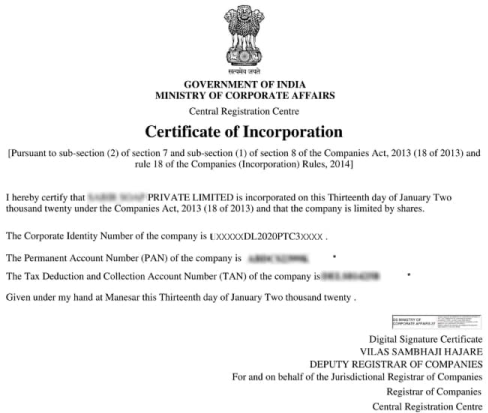
What is a Company Registration Certificate?
A Company Registration Certificate, officially called the Certificate of
Incorporation, is a government-issued document that legally validates the formation
of a company in India under the Companies Act, 2013. It is generated digitally by
the Registrar of Companies (RoC) under the Ministry of Corporate Affairs (MCA) after
successful submission and approval of incorporation documents, as per Section 7(2)
of the Companies Act, 2013.
This certificate confirms that your business is a distinct legal entity, capable of
owning assets, opening bank accounts, applying for statutory registrations, raising
investment, and entering into enforceable contracts in its own name.
What Does the Incorporation Certificate Contain?
The Certificate of Incorporation includes key company details such as:
-
Company Name (as approved during the SPICe+ filing)
-
Corporate Identification Number (CIN) – the unique company ID assigned by the MCA
-
Date of Incorporation – the official date your business is legally formed
-
PAN and TAN – issued if applied for during incorporation
-
Company Structure – such as Private Limited, LLP, or One Person Company (OPC)
-
Registered Office Address – the legal address of the company
-
Think of this certificate as your company’s legal birth certificate—it authorizes your business to operate formally within India’s regulatory framework.
How to Get Certificate of Incorporation?
To receive your Certificate of Incorporation from the MCA:
-
Complete SPICe+ Form (Part A for name reservation, Part B for incorporation) via the MCA portal
-
Upload required documents, including:
-
Memorandum of Association (MoA)
-
Articles of Association (AoA)
-
Identity and address proofs of directors/shareholders
-
Digital Signature Certificate (DSC) and Director Identification Number (DIN)
-
-
Await RoC approval: Upon successful verification, the Certificate of Incorporation is issued digitally and made available on the MCA portal.
-
Note: No physical copy is issued. Download the certificate from your MCA account once approved.
Why Is the Company Registration Certificate Important?
This certificate is legally required to:
-
Open a current bank account in the company’s name
-
Apply for GST, MSME, FSSAI, or other statutory registrations
-
Raise venture capital or funding from investors and financial institutions
-
Enter into formal contracts with vendors, clients, and government bodies
-
Participate in tenders, import-export activities, and regulatory filings
What Are the Post-Incorporation Compliances for a Company?
After registering your company in India, it is crucial to follow all the post-registration company compliances. Based on the type of company with which you have registered, the compliances vary. However, performing a statutory audit, filing annual returns, staying abreast of ROC compliance, maintaining statutory registers, and filing your GST returns are some of the post-registration compliances that you should not miss.
Annual Compliance
Annual filings, Audits, and entity-specific regulatory compliance, such as ROC filings and Tax audits
Accounting & Book keeping
Accounting, tax planning, GST compliance, income tax filing, and financial record-keeping aligned with current accounting standards
Other registration
MSME, IEC, ISO, FSSAI [Food License], Apeda RCMC, Liquor license, Firearm license
Corporate Secretarial
Meetings, Governance compliance, Regulatory filings, Expert board advisors
Why Choose Adventus for Company Registration in India
Adventus stands out for simplifying the company registration process by offering expert guidance, a user-friendly online platform, and personalized solutions. Businesses benefit from our expert assistance in document preparation, transparent pricing, and timely updates on registration progress. Adventus's commitment to legal compliance ensures that businesses navigate complexities seamlessly, receiving post-registration support for ongoing compliance requirements. With a focus on accessibility and technology, we empower businesses to complete the registration process efficiently, allowing them to concentrate on their core operations with confidence in their legal standing.

Not Sure About Your Business Type?
Feeling uncertain about the ideal business structure? Consult with our experts for guidance and support in finding the right one for you
Top Reasons Clients Choose Adventus for Company Registration
Benefits worth up to 4 lakhs when you register a Company with us!

Current Bank
-
Zero Balance current account for 1 year
-
Get upto 7% interest on deposits
-
No server or hosting fee

Cloud based HRMS payroll
-
Few tap attendance/Leave tracking
-
Mobile app for employees
-
No server or hosting fee

Cross Border Payment Solutions
-
Get a FREE international bank account!
-
Save up to 30% on forex rates!
-
Get money into your account within 24 hours

Marketing Service
-
Create your website within minutes
-
Get a custom domain
-
No server or hosting fee

Neo Bank for small business owners
-
Business loan approved in under 72 hours
-
Collateral-free loans
-
Digital process, minimal documentation

Marketing Service
-
Get Directors & Officers Insurance
-
Crime Insurance
-
Product Liability Insurance